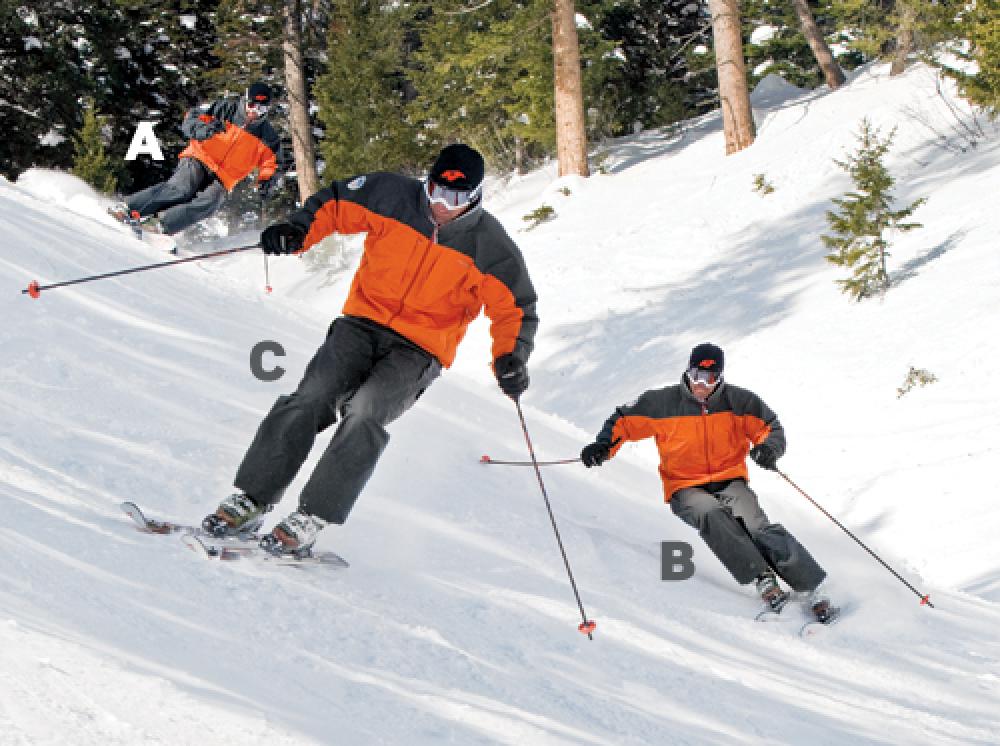
When a trail is cut to direct traffic in one direction but gravity pulls skiers in another, everyone gets sucked to the same area―the downhill border of the trail. This leaves a lane of scraped-off snow down the middle of the run and a berm of untidy harbor chop along the edges.
Because everyone succumbs to the pull of the fall line rather than follow the path of the trail, good snow often remains uphill. Learn to love the double fall line and its uphill spoils. You’ll have to work hard to resist gravity’s forces, but hold the high line and you’ll get the goods.
Long and strong
A. On this slope, the fall line runs nearly perpendicular to the trail, so you have to keep this turn short or you’ll get pulled down into the bad snow. Just get to the fall line; don’t turn your skis past it.
B.*KEY MOVE (see next slide) Be prepared to make asymmetrical turns (small at the top of the side-hill; big near the bottom). As the fall line and the slope begin to align, your turns will gradually become more symmetrical.
C. Make a strong turn here: Use your momentum to pull you up the hill. Get on the inside edge of your outside ski early, and let your ski’s sidecut work, carving until you’ve reached the high side of the trail.
Key Move
If you find yourself dangerously close to the gully, it’s because your previous turn was too long. To avoid getting pulled into the drainage, you’ll have to make a more complete turn in the other direction.
Incorrect In a double fall-line situation, gravity isn’t your friend. If your skis don’t come perpendicular to―or even beyond―the fall line, they’ll slide down it into the ravine, where a bumpy ride through bad snow is inevitable.
Correct To get back on the high line, you essentially have to fight against gravity, which is pulling you into the gully. Widen your stance, and let your skis carve―longer than you might expect―across the fall line and up the hill. Your skis will swoop back up the slope and onto the good snow.
Tune-Up Tip
Practice mixing turn shapes and sizes. That is what enables you to control where you’ll ski in relation to the fall line. Start by making a series of short-swing pivot turns in an imaginary corridor that’s about 10 feet wide. Once you’ve established a solid rhythm, widen your corridor to about 20 feet. As your rhythm changes, adjust the way you blend your movements―flattening to pivot your skis, edging to bend them or some combination of both.
1. On the high side of a hill, you’ll make classic short-swing turns. With a narrow stance and your upper body facing more or less straight ahead, you can pivot your skis from right to left while holding a strong edge.
2. To transition from a pivoted turn on the high side to a carved turn on the low side, push your skis out from under your body.
Let their sidecut engage to pull you well past the fall line to widen your corridor.
3. As your skis bend, they’ll naturally change direction. Keep turning with them, and let momentum carry you back up to the high side. There’s little―if any―reason to pivot your skis here: Just let them carve.
如是,只应该从亮冰地段以下开始尝试滑降。
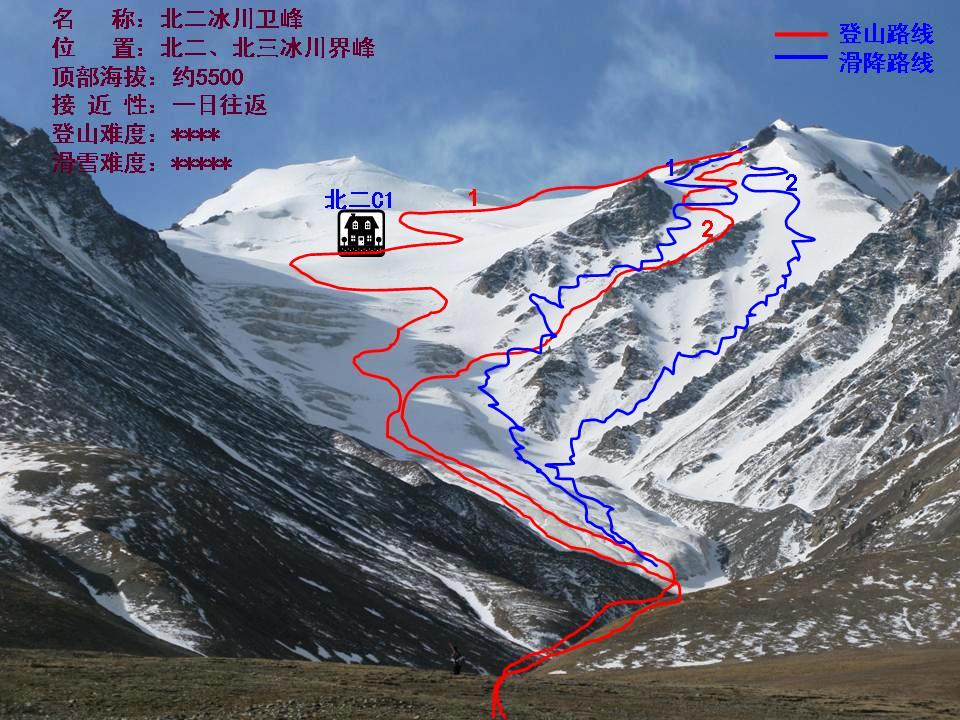
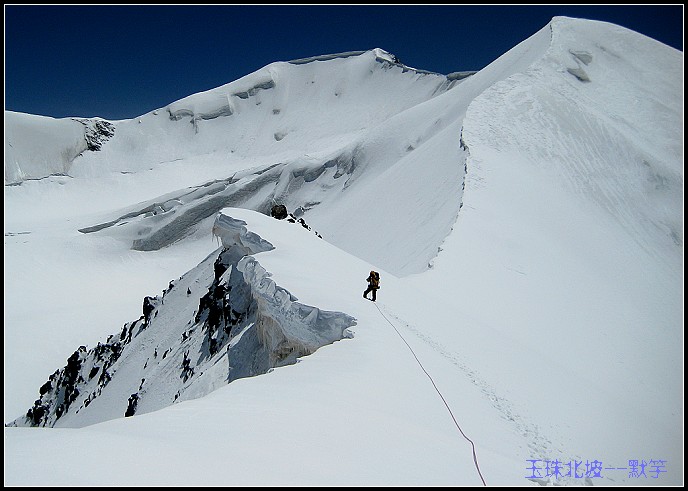
“北二冰川C2与5920峰之间有一段大刃脊(见图,借迪庆的照片了),一般有一层20cm左右薄雪,下面是冰。像这种地形,Skin on是否合适?”
爬升--亮冰地带开始至峰顶,这种坡度和冰况,不适合SKINNING ON,打滑、倒栽的几率太高了!
碰到这种情况,应该将雪板摘下留在冰坡段下面,穿上正儿八经的攀冰冰爪,Moving uphill with ice axe and ski pole-The slope is ascended directly facing uphill and descended directly facing downhill. ... Using a ski pole is highly recommended for both maintaining balance and for ... When moving forwards, the ice axe is held in the favored hand. ...
www.grivel.com/Tecnica/Tecnica_Corsi.asp?Corso=1 - -即用一只手使用冰镐、另一只手使用雪杖的交叉步爬升(CROSS OVER STEP).或者打路可、做保护.....。
1275619322,露水